
BLOGS
Company Culture Stories
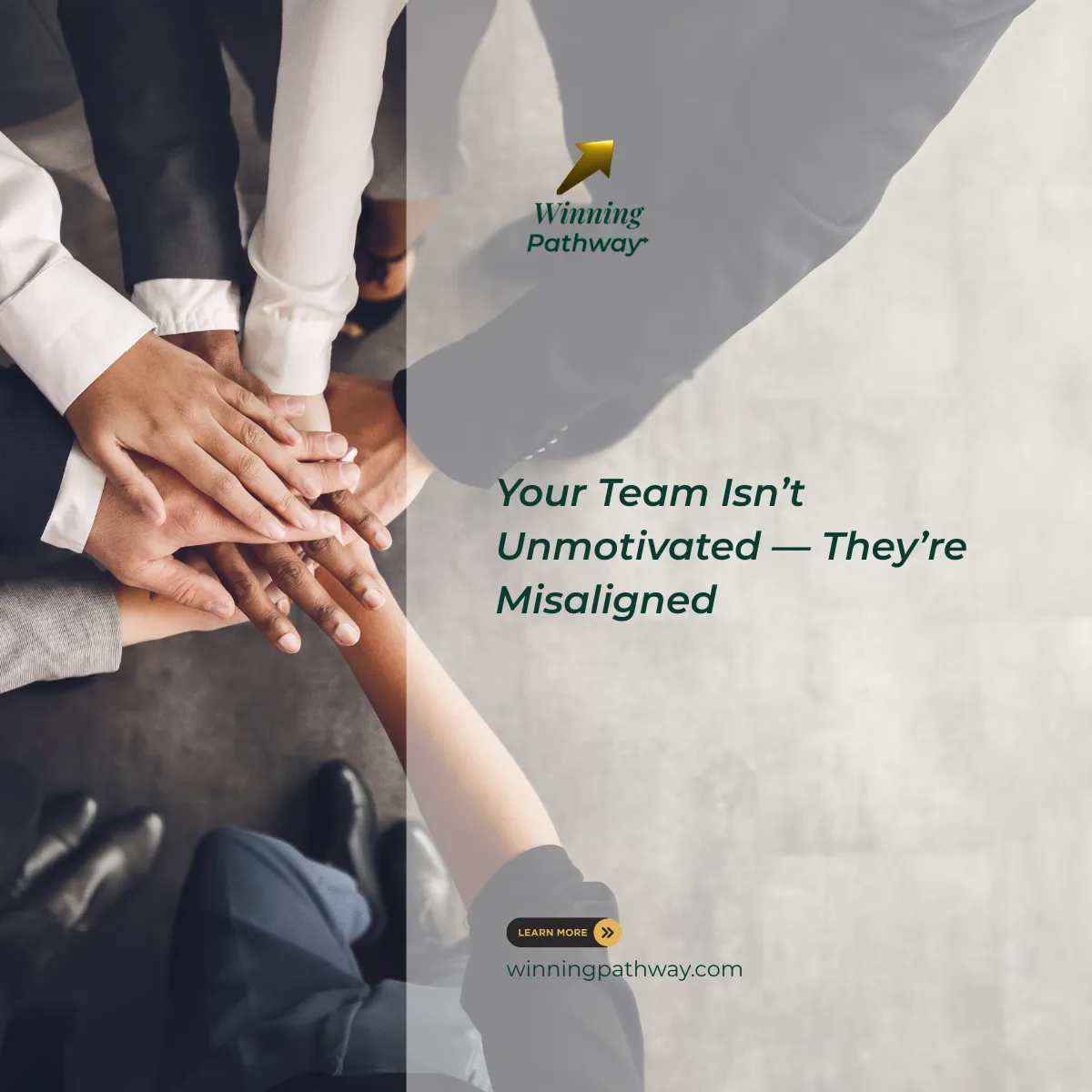
Most Teams Aren’t Unmotivated — They’re Misaligned
Most Teams Aren’t Unmotivated. They’re Misaligned.

When teams seem tired, disengaged, or slightly off, leaders often assume the problem is motivation. So they respond with more goals, new incentives, or additional meetings meant to reenergize performance.
But what if motivation is not the real issue.
What if the underlying problem is misalignment.
This is the core insight behind Winning Pathway’s work on team performance. When people are misaligned internally and collectively, motivation naturally drains, even when talent and effort remain high.
Why Motivation Gets Blamed First
Motivation is visible. It feels actionable. Leaders can measure it, track it, and attempt to influence it through familiar tools like incentives, targets, or recognition.
But motivation is not the primary driver of sustained performance.
Alignment is.
When people are unclear about what the team is truly working toward, how their role contributes, or where the organization is headed, motivation does not disappear dramatically. It fades quietly. People still show up. Work still gets done. But energy, confidence, and engagement slowly decline.
This is not apathy. It is confusion.
What Misalignment Looks Like In Real Teams
Misalignment rarely announces itself directly. It shows up through patterns that feel frustrating but hard to diagnose.
Teams may rehash the same topics in every meeting without resolution. Decisions take longer than necessary or keep getting revisited. Shared context is missing, so people work hard but pull in different directions. Teams stay busy yet feel unproductive at the end of the week.
These are not performance failures. They are signals.
People care. They simply are not anchored to the same clarity of purpose, priorities, and expectations.
The Shift That Restores Energy And Ownership
When the internal block of misalignment is identified and addressed, something shifts quickly.
Energy returns because people know what matters. Collaboration improves because priorities are shared. Ownership reemerges because roles and expectations are clear. Meetings become purposeful again instead of repetitive.
Leaders do not have to push harder. They help teams realign.
When alignment is restored, motivation follows naturally. It no longer has to be manufactured.
A Practical Reframe For Leaders
Teams are rarely unmotivated by nature.
More often, they are navigating unclear direction, mixed signals, or competing assumptions about what success actually looks like.
Before adding more meetings, incentives, or initiatives, it is worth asking a different set of questions.
Where is clarity missing right now.
What assumptions are different across the team.
Are goals, priorities, and decision rights truly aligned.
The answers to those questions often reveal exactly where performance has become blocked.
Alignment is not a soft issue. It is the foundation that allows motivation, execution, and results to sustain over time.
To explore this further, you can follow Dr. Sarai Koo on LinkedIn for insights on leadership under pressure, and watch her content on Dr. Sarai Koo’s YouTube Channel, Instagram, and TikToK for real-world leadership scenarios and practical solutions. You can also subscribe to the LinkedIn Newsletter: Integration Under Pressure for deeper system-level perspectives, and visit Winning Pathway LinkedIn Page and the Leadership Hub Blog to see how regulated, psychologically safe systems translate into measurable business outcomes.
Human Development * Life Transformation
Most Teams Aren’t Unmotivated — They’re Misaligned
Most Teams Aren’t Unmotivated. They’re Misaligned.
When teams seem tired, disengaged, or slightly off, leaders often assume the problem is motivation. So they respond with more goals, new incentives, or additional meetings meant to reenergize performance.
But what if motivation is not the real issue.
What if the underlying problem is misalignment.
This is the core insight behind Winning Pathway’s work on team performance. When people are misaligned internally and collectively, motivation naturally drains, even when talent and effort remain high.
Why Motivation Gets Blamed First
Motivation is visible. It feels actionable. Leaders can measure it, track it, and attempt to influence it through familiar tools like incentives, targets, or recognition.
But motivation is not the primary driver of sustained performance.
Alignment is.
When people are unclear about what the team is truly working toward, how their role contributes, or where the organization is headed, motivation does not disappear dramatically. It fades quietly. People still show up. Work still gets done. But energy, confidence, and engagement slowly decline.
This is not apathy. It is confusion.
What Misalignment Looks Like In Real Teams
Misalignment rarely announces itself directly. It shows up through patterns that feel frustrating but hard to diagnose.
Teams may rehash the same topics in every meeting without resolution. Decisions take longer than necessary or keep getting revisited. Shared context is missing, so people work hard but pull in different directions. Teams stay busy yet feel unproductive at the end of the week.
These are not performance failures. They are signals.
People care. They simply are not anchored to the same clarity of purpose, priorities, and expectations.
The Shift That Restores Energy And Ownership
When the internal block of misalignment is identified and addressed, something shifts quickly.
Energy returns because people know what matters. Collaboration improves because priorities are shared. Ownership reemerges because roles and expectations are clear. Meetings become purposeful again instead of repetitive.
Leaders do not have to push harder. They help teams realign.
When alignment is restored, motivation follows naturally. It no longer has to be manufactured.
A Practical Reframe For Leaders
Teams are rarely unmotivated by nature.
More often, they are navigating unclear direction, mixed signals, or competing assumptions about what success actually looks like.
Before adding more meetings, incentives, or initiatives, it is worth asking a different set of questions.
Where is clarity missing right now.
What assumptions are different across the team.
Are goals, priorities, and decision rights truly aligned.
The answers to those questions often reveal exactly where performance has become blocked.
Alignment is not a soft issue. It is the foundation that allows motivation, execution, and results to sustain over time.
To explore this further, you can follow Dr. Sarai Koo on LinkedIn for insights on leadership under pressure, and watch her content on Dr. Sarai Koo’s YouTube Channel, Instagram, and TikToK for real-world leadership scenarios and practical solutions. You can also subscribe to the LinkedIn Newsletter: Integration Under Pressure for deeper system-level perspectives, and visit Winning Pathway LinkedIn Page and the Leadership Hub Blog to see how regulated, psychologically safe systems translate into measurable business outcomes.